What 8 a.m. Prices Got Right and Wrong
At 8 a.m. Taipei time on Nov. 28, 2026, Polymarket priced Chang Chia-chun (張嘉郡) at 82% in Yunlin County, Johnny Chiang (江啟臣) at 74.5% in Taichung and Su Chiao-hui (蘇巧慧) at 63% in New Taipei. Under unofficial Central Election Commission (CEC) tallies recorded at 00:21 Taipei time on Nov. 29, all three lost to Liu Chien-kuo (劉建國), Ho Hsin-chun (何欣純) and Lee Shu-chuan (李四川). Overall, Polymarket's 8 a.m. favorite won 19 of 22 mayor and magistrate races, including all 9 at 90% or higher. Of 5 races decided within 4 percentage points, Polymarket missed 3 and got 2 right: Hualien County (0.21 percentage points) and Keelung (3.66).
In the 8 scorable races covered by both platforms, Kalshi and Polymarket favored the same candidate and both got 6 right. Still, this is one election, and 22 races are too few to establish reliable forecasting ability or justify betting. Taiwan's Public Officials Election and Recall Act (Article 103-1) makes gambling on election outcomes, including online, a criminal offense; this InfoMiner Election Lab review analyzes public prices only.
How to Read a 63% Price
Treating 63% as an implied win chance is only a rough reading, not a validated probability or vote share. Fees and thin trading shape prices, and a few trades can move small markets.
What Market Prices Are Not
Market prices are not vote shares, polls or InfoMiner forecasts.
Below, the 22 races are sorted by Polymarket's 8 a.m. favorite price on Nov. 28: all 9 at 90% or higher won, two misses sat from 70% to under 90% and one sat below 70%.
- Kinmen County99%Chen Yu-jen✓ Right
- Miaoli County96.2%Chung Tung-chin✓ Right
- Nantou County95%Hsu Shu-hua✓ Right
- Pingtung County95%Chou Chun-mi✓ Right
- Tainan93.8%Chen Ting-fei✓ Right
- Chiayi County93.4%Tsai Yi-yu✓ Right
- Hsinchu City92.5%Kao Hung-an✓ Right
- Chiayi City91%Wang Mei-hui✓ Right
- Taoyuan90.5%Chang San-cheng✓ Right
- Taitung County89.5%Wu Hsiu-hua✓ Right
- Hualien County*87.1%Yu Shu-chen✓ Right
- Lienchiang County87%Wang Chung-ming✓ Right
- Changhua County84%Chen Su-yueh✓ Right
- Yunlin County*82%Chang Chia-chun✗ Wrong: Liu Chien-kuo won (by 0.05 pp)
- Yilan County80.5%Lin Kuo-chang✓ Right
- Kaohsiung78.5%Lai Jui-lung✓ Right
- Taichung74.5%Johnny Chiang✗ Wrong: Ho Hsin-chun won (by 2.29 pp)
- Penghu County71.5%Chen Chen-chung✓ Right
- Hsinchu County68%Cheng Chao-fang✓ Right
- New Taipei63%Su Chiao-hui✗ Wrong: Lee Shu-chuan won (by 2.97 pp)
- Taipei56.5%Chiang Wan-an✓ Right
- Keelung56.5%Hsieh Kuo-liang✓ Right
Each tile shows Polymarket's favorite and that candidate's market price at 08:00 on Nov 28, roughly how confident the market was that this candidate would win. It is not a vote share. * Yunlin and Hualien are within the recount threshold.
Nine for nine is still only nine races.
The Three Races Polymarket Missed
- New Taipei: Polymarket favored Su Chiao-hui at 63%; Lee Shu-chuan won by 2.97 percentage points after lead shifts in daily 8 a.m. observations.
- Taichung: Polymarket favored Johnny Chiang at 74.5%; Ho Hsin-chun won by 2.29 percentage points and never led in daily 8 a.m. observations.
- Yunlin County: Polymarket favored Chang Chia-chun at 82%; Liu Chien-kuo won by 173 votes (0.05 percentage points), within the recount threshold (estimated pre-vote volume upper bound: about US$10,000).
Why Prices Are Not Margins
Prices show a moderate positive correlation with margins overall, but a win-market price is not a predicted vote share or margin. At 8 a.m., Chiang Wan-an (蔣萬安) stood at 56.5% (61.5% a day earlier) and won Taipei by 8.03 percentage points; Cheng Chao-fang (鄭朝方) stood at 68% and won Hsinchu County by 16.97; Yu Shu-chen (游淑貞) stood at 87.1% and won Hualien County by 0.21.
Polls and Possible Recounts
Across 16 jurisdictions with compatible pre-blackout polls (published by Nov. 17), Polymarket's favorite won 13 and the leader in our weighted benchmark of compatible polls won 12, with 11 extra days of market information. Polymarket alone got Kaohsiung and Keelung right (poll leads: 1.5 and 2.0 percentage points; New Taipei: 0.6), while the poll benchmark alone got Taichung right (Ho led by 10.7). Too few races exist to judge accuracy.
Trailing candidates in Yunlin (173 votes) and Hualien (357 votes) said they would request recounts. If only one county flips, Polymarket's score becomes 20 of 22 (Yunlin) or 18 of 22 (Hualien); if both flip, it stays at 19 of 22.
In-Depth Analysis: Full Data and Methods
This analysis by InfoMiner Election Lab at LargitData (大數軟體) is a post-election retrospective evaluation, not a pre-registered forecast test. While all market prices were generated before voting began, the evaluation rules were written on Nov. 29 after unofficial results became public and before historical price data were downloaded, with one additional eligibility rule added during review. With only 22 races, statistical uncertainty is wide: the 95% Wilson confidence interval runs from 67% to 95% for Polymarket (19 of 22) and from 41% to 93% for Kalshi (6 of 8). Meanwhile, two tight results, Yunlin County (173 votes) and Hualien County (357 votes), fall within Taiwan's legal recount threshold, and the trailing candidates in both counties have stated they will petition for recounts.
How to read this report
All election outcomes cited here are unofficial Central Election Commission (CEC) tallies recorded at 00:21 Taipei time on Nov. 29, 2026, with all polling stations reporting. The CEC schedule sets the official proclamation of results for Dec. 4, while the Central News Agency reported Dec. 2. Throughout this report, market prices are expressed as percentages (for example, 63% rather than 0.63). Market prices reflect contract trading levels before voting, not predicted vote shares, opinion polls or InfoMiner projections.
The summary box below highlights the headline hit rates, recount sensitivity and pre-election trading volume across both platforms before we examine individual races.
Polymarket favorites won
19/22
22 mayor/magistrate races; 18/20 excluding Yunlin and Hualien (within recount threshold)
Kalshi favorites won
6/8
8 scorable races (Taoyuan market opened on voting day, not scored)
Actual margins in missed races
< 3 pp
New Taipei 2.97 pp, Taichung 2.29 pp, Yunlin County 0.05 pp
Same 16 counties: markets vs polls
13 vs 12
Polymarket 13, poll leader 12; too few races to rank them
Pre-vote trading volume
≤ US$14.8M
Polymarket up to about US$14.8M; Kalshi about US$1.83M (excludes counting night)
Headline Hit Rates and Recount Scenarios
To establish a consistent benchmark, we evaluated each market at time T: 8 a.m. Taipei time on Nov. 28, 2026, the moment voting started. In each race, the market favorite is defined as the officially registered candidate holding the highest display price at T. Contracts labeled "Other" or listing non-candidates were excluded; across every city and county, their combined price at T was 0.5% or less.
Polymarket listed markets for all 22 county magistrate and city mayor races, covering 58 of the 81 officially registered candidates, including every eventual winner. The candidate Polymarket favored at T went on to win 19 of 22 contests, with a 95% Wilson confidence interval of 67% to 95%. Kalshi listed 9 races (Taiwan's six special municipalities plus Keelung, Hsinchu City and Hsinchu County), covering 29 of 32 official candidates and every eventual winner in those races. Under an eligibility rule added after review, markets open for less than 24 hours before voting began were excluded from scoring. That removed Kalshi's Taoyuan market, which opened at 3:30 a.m. Taipei time on Nov. 28 and logged only 3 contracts traded before T. Across its 8 scorable races, the candidate Kalshi favored at T went on to win 6 of 8 (95% Wilson confidence interval: 41% to 93%).
Because two tight counties remain subject to potential recounts, Polymarket's final tally could still shift:
- Current unofficial results: 19 of 22.
- If Yunlin County flips: 20 of 22.
- If Hualien County flips: 18 of 22.
- If both Yunlin County and Hualien County flip: 19 of 22.
- If both counties are excluded: 18 of 20.
We also checked Polymarket's hit rate at earlier and later timestamps to test whether the result depended on the exact 8 a.m. cutoff. At 1, 3, 7 and 14 days before T, as well as at midnight (00:00) and poll closing (4 p.m. Taipei time) on Nov. 28, Polymarket produced the exact same 19 of 22 score and missed the exact same three races. Earlier in the campaign, at 30 and 60 days before T, Polymarket stood at 20 of 22 because it still favored Lee Shu-chuan (李四川) in New Taipei while missing Taichung and Yunlin County. At 90 days before T, it was 19 of 22, missing Taichung, Hsinchu County and Yunlin County. On Kalshi, replacing display prices with last-traded prices across all 8 scorable races left the result unchanged at 6 of 8.
The table below lists all 22 races, showing each platform's pre-election favorite, the price at 8 a.m. on Nov. 28, the unofficial winner, the vote-share margin and whether the race falls within the recount threshold.
| City/County | Winner (party) | Vote-share margin (pp) | Polymarket favorite | Hit | Kalshi favorite | Hit |
|---|---|---|---|---|---|---|
| Taipei | Chiang Wan-an (KMT) | 8.03 | Chiang Wan-an 56.5% | ✓ | Chiang Wan-an 54.5% | ✓ |
| New Taipei | Lee Shu-chuan (KMT) | 2.97 | Su Chiao-hui 63% | ✗ | Su Chiao-hui 63.5% | ✗ |
| Taoyuan | Chang San-cheng (KMT) | 11.35 | Chang San-cheng 90.5% | ✓ | not scored | — |
| Taichung | Ho Hsin-chun (DPP) | 2.29 | Johnny Chiang 74.5% | ✗ | Johnny Chiang 73% | ✗ |
| Tainan | Chen Ting-fei (DPP) | 7.78 | Chen Ting-fei 93.8% | ✓ | Chen Ting-fei 95.5% | ✓ |
| Kaohsiung | Lai Jui-lung (DPP) | 7.11 | Lai Jui-lung 78.5% | ✓ | Lai Jui-lung 80.5% | ✓ |
| Hsinchu County | Cheng Chao-fang (DPP) | 16.97 | Cheng Chao-fang 68% | ✓ | Cheng Chao-fang 68.5% | ✓ |
| Miaoli County | Chung Tung-chin (KMT) | 24.42 | Chung Tung-chin 96.2% | ✓ | no market | — |
| Changhua County | Chen Su-yueh (DPP) | 5.45 | Chen Su-yueh 84% | ✓ | no market | — |
| Nantou County | Hsu Shu-hua (KMT) | 24.99 | Hsu Shu-hua 95% | ✓ | no market | — |
| Yunlin County* | Liu Chien-kuo (DPP) | 0.05 | Chang Chia-chun 82% | ✗ | no market | — |
| Chiayi County | Tsai Yi-yu (DPP) | 11.73 | Tsai Yi-yu 93.4% | ✓ | no market | — |
| Pingtung County | Chou Chun-mi (DPP) | 22.92 | Chou Chun-mi 95% | ✓ | no market | — |
| Yilan County | Lin Kuo-chang (DPP) | 9.41 | Lin Kuo-chang 80.5% | ✓ | no market | — |
| Hualien County* | Yu Shu-chen (KMT) | 0.21 | Yu Shu-chen 87.1% | ✓ | no market | — |
| Taitung County | Wu Hsiu-hua (KMT) | 24.96 | Wu Hsiu-hua 89.5% | ✓ | no market | — |
| Penghu County | Chen Chen-chung (KMT) | 10.90 | Chen Chen-chung 71.5% | ✓ | no market | — |
| Kinmen County | Chen Yu-jen (KMT) | 34.23 | Chen Yu-jen 99% | ✓ | no market | — |
| Lienchiang County | Wang Chung-ming (KMT) | 16.65 | Wang Chung-ming 87% | ✓ | no market | — |
| Keelung | Hsieh Kuo-liang (KMT) | 3.66 | Hsieh Kuo-liang 56.5% | ✓ | Hsieh Kuo-liang 59.5% | ✓ |
| Hsinchu City | Kao Hung-an (Independent) | 17.74 | Kao Hung-an 92.5% | ✓ | Kao Hung-an 92.5% | ✓ |
| Chiayi City | Wang Mei-hui (DPP) | 11.03 | Wang Mei-hui 91% | ✓ | no market | — |
Prices are each platform's displayed price at 08:00 Taipei time on Nov 28, 2026, shown to one decimal place where needed; groupings use unrounded values. Margin is the vote-share gap in the unofficial CEC count. * Yunlin and Hualien are within the recount threshold.
Polymarket and Kalshi: Near-Identical Calls on Eight Shared Races
On the 8 scorable races listed on both platforms, Polymarket and Kalshi behaved almost identically. Both platforms selected the exact same favorite in all 8 contests, both scored 6 of 8, and both missed New Taipei and Taichung. Comparing prices for the same candidate at T, the largest gap between the two platforms was 3 percentage points.
To measure probability accuracy beyond simple win-or-loss counts, we calculated Brier scores (where lower values indicate closer alignment with actual outcomes) strictly on the shared set of 19 candidate contracts across those 8 races. Polymarket posted a Brier score of 0.157 and Kalshi posted 0.153. Summed per race across the same 8 contests, the figures were 0.372 for Polymarket and 0.364 for Kalshi. Because different sets of races have different levels of competitiveness, Brier scores should not be compared across unmatched race lists.
The practical takeaway is straightforward: Polymarket and Kalshi tracked each other so closely that their agreement should not be treated as two independent confirmations. In the chart below, readers can compare the two platforms' prices for the same candidates across the 8 shared contests.
Both platforms had the same favorite in every shared race and prices for the same candidate differed by at most 3 percentage points, so they are not two independent tests.
The Three Misses and Taipei, Where the Favorite Won
To see how prices evolved ahead of voting, we sampled daily 8 a.m. Taipei time prices in four closely watched races: the three contests the markets missed, plus Taipei, where the favorite won even though the favorite's price had fallen to its lowest level since mid-August.
New Taipei: A Late Shift Away From the Eventual Winner
In New Taipei, Kuomintang (KMT) candidate Lee Shu-chuan (李四川) won by 2.97 percentage points, while both markets favored Democratic Progressive Party (DPP) candidate Su Chiao-hui (蘇巧慧) in the final weeks before voting. In the study's daily 8 a.m. observations on Polymarket, Lee traded between 76.5% and 81% from Aug. 15 to Sept. 15, fell to 66% on Sept. 18, and ranged between 66% and 77.5% in the second half of September. The daily 8 a.m. observations first showed Su leading on Oct. 16, briefly showed Lee ahead again on Oct. 29, and returned to Su on Nov. 5 through election morning. At T, Su traded at 63% on Polymarket and 63.5% on Kalshi. Watch the lead reversals across October and early November in the chart below.
Solid: Polymarket; dashed: Kalshi. Top two finishers only. Counting-night prices are not shown.
Taichung: The Winner Never Led in Either Market
In Taichung, DPP candidate Ho Hsin-chun (何欣純) won by 2.29 percentage points, but Ho never led in the study's daily 8 a.m. observations on either market. On Polymarket, Ho traded between 3.55% and 8.5% from Aug. 15 to Sept. 15 and at about 10% to 12.65% in late September, jumped from 14.7% to 26.8% on Oct. 11 in mid-October, touched a daily-series high of 33% on Oct. 24 and fell back to about 24% the next day, traded roughly between 14% and 26% afterwards, stood at 20% the day before the vote, and was at about 26% at T, while KMT favorite Johnny Chiang (江啟臣) stood at 74.5%. On Kalshi, Ho stood at 27.5% at T, with a last pre-election trade of 33%. The chart below shows Ho's October climb and the gap that remained on election morning.
Solid: Polymarket; dashed: Kalshi. Top two finishers only. Counting-night prices are not shown.
Yunlin County: A Thin Market Decided by 173 Votes
In Yunlin County, DPP candidate Liu Chien-kuo (劉建國) led by 173 votes, or 0.05 percentage points, in unofficial results, a margin inside the recount threshold. Throughout the observed period on Polymarket, Liu traded between roughly 6% and 23%, standing at 17% at T while KMT favorite Chang Chia-chun (張嘉郡) stood at 82%. Unlike New Taipei and Taichung, Yunlin County was a very thin market before the vote: the estimated upper bound on pre-vote volume was about US$10,000. Of roughly US$105,000 traded by the time of data collection, about 90% fell within the 24-hour window from 1:36 p.m. Nov. 28 to 1:36 p.m. Nov. 29 Taipei time, entirely after polls opened; the data cannot isolate counting-night trading.
Solid: Polymarket; dashed: Kalshi. Top two finishers only. Counting-night prices are not shown.
Taipei: Right Direction, Lowest Price Since Mid-August
Taipei illustrates why a win-market price cannot be read as a predicted vote share or winning margin. Both platforms correctly favored Chiang Wan-an (蔣萬安), who won by 8.03 percentage points. Chiang's Polymarket price fell from about 90% in August to 56.5% at T (the lowest reading in the daily 8 a.m. series since Aug. 15, and down from 61.5% one day earlier), while Kalshi priced Chiang at 54.5% at T. In the chart below, follow how Chiang's price tightened ahead of election day alongside an eventual margin exceeding 8 percentage points.
Solid: Polymarket; dashed: Kalshi. Top two finishers only. Counting-night prices are not shown.
Price Confidence, Margins and Calibration
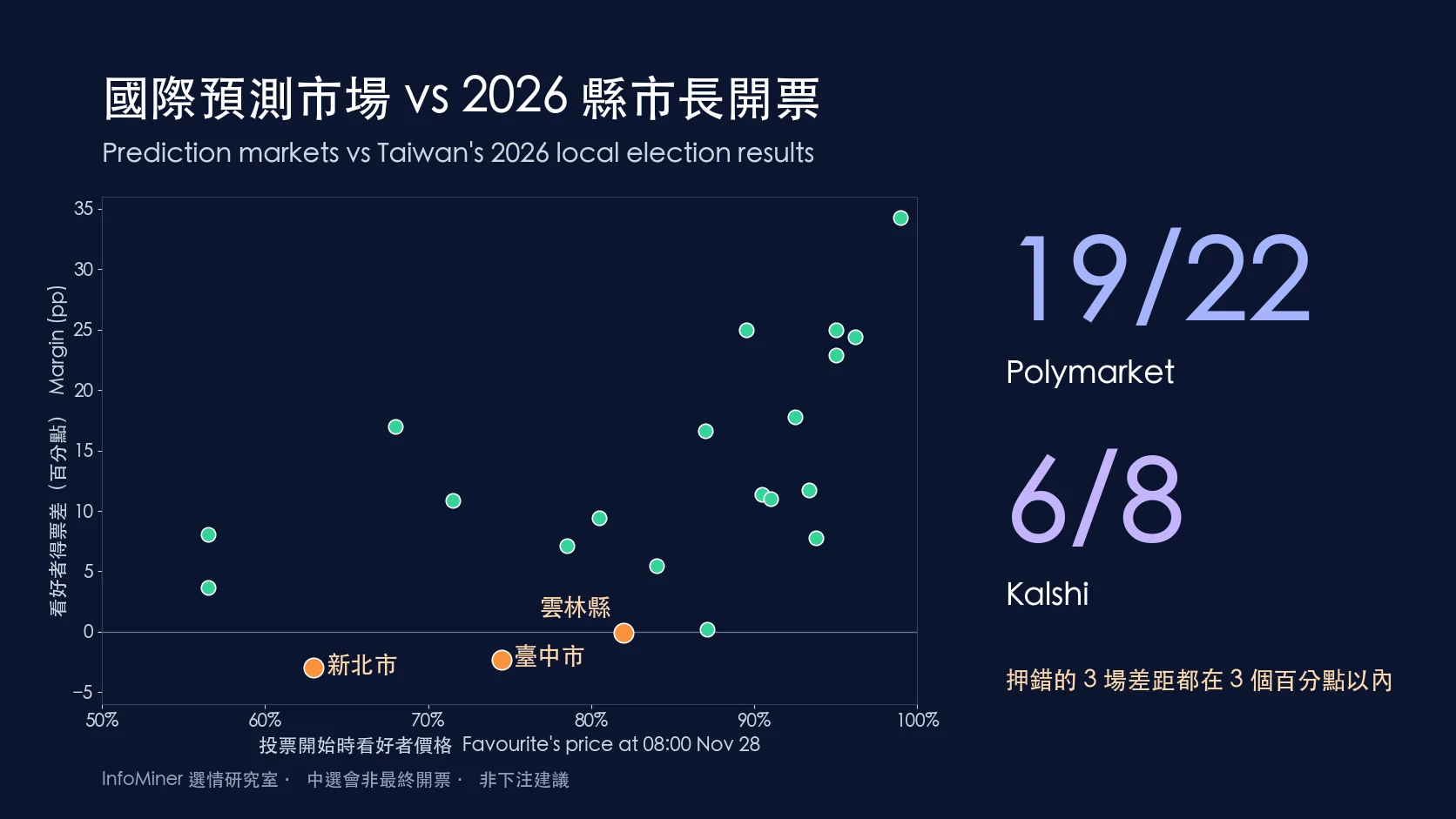
Across all 22 races on Polymarket, higher pre-election prices generally aligned with wider vote-share margins for the favored candidate. Comparing each favorite's price at T against its signed actual vote-share margin produced a Pearson correlation of 0.58 and a Spearman rank correlation of 0.67. In the scatter plot below, look at how the three missed races cluster in the lower-margin portion of the chart rather than among high-confidence favorites.
X axis: the favorite's price when polls opened. Y axis: the favorite's actual lead (positive) or deficit (negative) in percentage points. Pearson 0.58, Spearman 0.67 (n=22).
Grouping races by the favorite's pre-election price, a split known before voting began, shows where the misses occurred:
- Favorite priced at 90% or higher: Polymarket went 9 of 9 (Taoyuan, Tainan, Miaoli County, Nantou County, Chiayi County, Pingtung County, Kinmen County, Hsinchu City and Chiayi City); Kalshi went 2 of 2.
- Favorite priced from 70% to 90%: Polymarket went 7 of 9, missing Taichung (favorite at 74.5%) and Yunlin County (favorite at 82%); Kalshi went 1 of 2.
- Favorite priced below 70%: Polymarket went 3 of 4, missing New Taipei (favorite at 63%); Kalshi went 3 of 4.
Looking back after results were known (an exploratory post-hoc split), Polymarket got all 17 races right where the unofficial winning margin was 4 percentage points or wider. In the 5 races decided by less than 4 percentage points, it got 2 right (Keelung and Hualien County) and missed 3 (New Taipei, Taichung and Yunlin County). The table below breaks down hit rates by pre-election price tier.
| Favorite's price | Polymarket | Kalshi |
|---|---|---|
| 90% or higher | 9/9 | 2/2 |
| 70% to under 90% | 7/9 | 1/2 |
| Below 70% | 3/4 | 3/4 |
Overall, the markets' implied confidence broadly matched how often favorites actually won. Summing the favorites' prices at T implied 18.25 expected wins on Polymarket, compared with 19 actual wins; on Kalshi, the sum implied 5.88 expected wins, compared with 6 actual wins. Because the sample is small, this alignment is descriptive rather than definitive.
Across all 58 candidate contracts on Polymarket at T, higher-price brackets generally won more often, though not strictly (the 10% to 30% bracket won 2 of 7 contracts while the 30% to 50% bracket won 1 of 4), and the bins are too small to draw firm conclusions:
- 0% to 10%: 25 contracts, average price 2.8%, 0 wins.
- 10% to 30%: 7 contracts, average price 19.1%, 2 wins (Ho Hsin-chun and Liu Chien-kuo).
- 30% to 50%: 4 contracts, average price 38.9%, 1 win (Lee Shu-chuan).
- 50% to 70%: 4 contracts, average price 61.0%, 3 wins.
- 70% to 90%: 9 contracts, average price 81.6%, 7 wins.
- 90% to 100%: 9 contracts, average price 94.0%, 9 wins.
In the calibration table below, compare each bracket's average price with the share of contracts that won, keeping the small bin sizes in mind.
| Price band | Polymarket contracts | Avg price | Won | Kalshi contracts | Avg price | Won |
|---|---|---|---|---|---|---|
| 0–10% | 25 | 2.8% | 0 | 13 | 1.5% | 0 |
| 10–30% | 7 | 19.1% | 2 | 2 | 24% | 1 |
| 30–50% | 4 | 38.9% | 1 | 4 | 38.5% | 1 |
| 50–70% | 4 | 61% | 3 | 4 | 61.5% | 3 |
| 70–90% | 9 | 81.6% | 7 | 2 | 76.8% | 1 |
| 90–100% | 9 | 94% | 9 | 2 | 94% | 2 |
How Markets Compared With Polls and Incumbency
To provide context without overstating what 22 races can prove, we compared the prediction markets against two baseline benchmarks strictly on identical subsets of cities and counties:
- P1 (weighted poll benchmark): The leader in our weighted benchmark of collected compatible opinion polls weighted with a 14-day half-life. We compiled these polls after the election; all were published by Nov. 17, before Taiwan's pre-election polling blackout. In five jurisdictions (Taoyuan, Yunlin County, Yilan County, Penghu County and Chiayi City), the available data included surveys more than 60 days old.
- B0a (incumbency and 2022-party benchmark): Picks the incumbent if running, or otherwise the nominee of the party that won that city or county in 2022.
Across the 16 cities and counties with P1 poll coverage, Polymarket's favorite won 13 and the poll leader won 12. Polymarket alone got Kaohsiung and Keelung right, where P1's leads were only 1.5 and 2.0 percentage points (New Taipei's P1 lead was 0.6 percentage points), close to a tie. P1 alone got Taichung right, where Ho Hsin-chun led by 10.7 percentage points in the weighted poll average while both prediction markets favored Johnny Chiang. Across the 20 jurisdictions with B0a coverage, Polymarket scored 17 and B0a scored 14. On Kalshi's 8 scorable races, Kalshi scored 6, Polymarket scored 6, P1 scored 5 and B0a scored 6.
These numbers do not show that prediction markets are either more accurate or less accurate than polls. At 8 a.m. on Nov. 28, markets incorporated 11 more days of developments than polls published by Nov. 17, and the difference on the shared 16-race subset was a single race. With such a small sample, no generalization is warranted. Review the matched-subset comparisons in the table below.
| Races compared | Polymarket | Kalshi | Poll leader (P1) | Incumbent-first rule (B0a) |
|---|---|---|---|---|
| 16 cities and counties with comparable polls | 13/16 | — | 12/16 | — |
| 20 cities and counties with a benchmark pick | 17/20 | — | — | 14/20 |
| 8 Kalshi-scorable races | 6/8 | 6/8 | 5/8 | 6/8 |
P1: leader of weighted compatible polls (14-day half-life), compiled after the vote; all polls were published by Nov 17, before the pre-election polling blackout. B0a: the incumbent if running, otherwise the nominee of the party that won in 2022. On voting day, markets had 11 more days of information than P1.
Party Direction: What the Numbers Show and Cannot Prove
Party totals in this analysis follow each candidate's official 2026 registration. Under that definition, Kao Hung-an (高虹安) is counted as an independent (having run under the Taiwan People's Party (TPP) in 2022), and Chung Tung-chin (鍾東錦) is counted as KMT (having run as an independent in 2022).
Across all 22 Polymarket races, pre-election favorites broke down as 12 KMT, 9 DPP and 1 independent, compared with unofficial winners of 11 KMT, 10 DPP and 1 independent. Summing all candidate prices by party yielded implied seat expectations of 11.17 for the KMT, 9.41 for the DPP and 1.17 for independents. The three misses split across both major parties: two favored KMT candidates in races won by DPP candidates (Taichung and Yunlin County), and one favored a DPP candidate in a race won by a KMT candidate (New Taipei). On Kalshi's 8 scorable races, the party breakdown of favorites (3 KMT, 4 DPP and 1 independent) matched the unofficial results exactly.
With 22 races and three errors split 2–1 across parties, these figures are strictly descriptive. The sample is far too small to conclude that prediction markets leaned toward or against any political party. The table below summarizes market favorites, implied seats and unofficial outcomes by party.
| KMT | DPP | Independent | |
|---|---|---|---|
| Polymarket favorites (22) | 12 | 9 | 1 |
| Winners (22) | 11 | 10 | 1 |
| Polymarket price sum (expected seats) | 11.17 | 9.41 | 1.17 |
| Kalshi favorites (8) | 3 | 4 | 1 |
| Winners (same 8) | 3 | 4 | 1 |
Trading Volume and What Market Data Cannot Tell Us
Because election-night trading reacts to live vote counts, we separated pre-election volume from cumulative totals. On Polymarket, cumulative volume across all 22 races reached US$21.2 million at the time of data collection, a figure that includes election night. The upper bound for pre-election volume was roughly US$14.8 million, with Taipei alone accounting for about US$11.1 million. Smaller counties saw far less activity, including roughly US$12,000 in Nantou County and about US$10,000 in Yunlin County. On Kalshi, pre-election volume across its 9 markets totaled about US$1.83 million (3.91 million contracts, out of 6.68 million contracts over the full period), with Taipei accounting for about US$1.32 million before voting.
By the estimated upper bound on pre-vote trading volume, New Taipei and Taichung ranked second and fifth among all 22 Polymarket races (an upper-bound ranking, not an actual one), whereas Yunlin County's upper bound was about US$10,000. The data cannot establish whether trading volume or liquidity played a role in the misses.
Equally important is what the datasets do not contain. Neither Polymarket nor Kalshi data provide the number of unique traders, their geographic locations or the concentration of holdings. Consequently, it is impossible to infer who was trading, whether participants were foreign nationals, or whether market prices reflected international public opinion.
National, Margin, Combo and Referendum Markets (Preliminary)
Beyond individual city and county races, both platforms offered aggregate, margin, multi-race combination and referendum contracts. Several remained unsettled pending official proclamation of results and potential recounts:
- Most seats won by the KMT: At T, Polymarket priced "KMT wins most county/city seats" at 79.5% and Kalshi priced it at 78.5%. Unofficial results show 11 KMT and 10 DPP. Under Polymarket's resolution rules, independents do not count toward any party and a tie goes to the party first in English alphabetical order: the Democratic Progressive Party. Kalshi's rules do not state a tie rule. If a Hualien County recount flipped that race and produced a 10-10 tie, Polymarket's rule would resolve the market to the DPP. Neither platform had settled the contract.
- Polymarket 9 special municipalities and provincial cities: The DPP was priced at 71%. Current unofficial tallies stand at 4 KMT, 4 DPP and 1 independent, which maps to the DPP under the same alphabetical tiebreaker; the market remained unsettled.
- Exact seat-count markets (very low volume): On DPP seat totals, "exactly 10 seats" led at 21%. On KMT seat totals, "exactly 11 seats" ranked third at 26%, behind the top option of 12 seats at 34.5%. Across all options in these two markets, prices summed to 103% and 172%, respectively.
- Taipei vote-margin markets: Chiang Wan-an won by 8.03 percentage points, narrowly clearing the 8% line. Polymarket priced Chiang winning by more than 8% (the 8%–12% and 12%+ brackets combined) at 14.45%, while Kalshi priced Chiang winning by 8% or more at 16%.
- Multi-race combination markets: On Polymarket's Taipei + New Taipei market, a DPP sweep stood at 35.5%, a KMT sweep (the unofficial outcome) at 28.5%, and a Taipei KMT / New Taipei DPP split at 28%. On Polymarket's New Taipei + Kaohsiung market, a DPP sweep stood at 49.5%, while New Taipei KMT / Kaohsiung DPP (the unofficial outcome) stood at 28.5%. On Polymarket's Hsinchu City + Hsinchu County market, Kao Hung-an + Cheng Chao-fang (鄭朝方) (the unofficial outcome) stood at 65.5%. On Kalshi's Taipei + New Taipei market, Puma Shen (沈伯洋) + Su Chiao-hui stood at 45.5%, compared with 24% for Chiang Wan-an + Lee Shu-chuan (the unofficial outcome).
- Referendum No. 22 (repealing the nuclear-free homeland policy): Kalshi priced "Pass" at 76.5%, and unofficial results show the measure passed.
The table below summarizes these auxiliary markets alongside the preliminary unofficial outcomes.
| Market | Outcome: price | Unofficial count |
|---|---|---|
| Polymarket: Party winning the most of 22 races | Kuomintang (KMT): 79.5%; Democratic Progressive Party (DPP): 21.1% | KMT 11, DPP 10, independent 1 (tie rule: alphabetical by English name = DPP) |
| Kalshi: Party winning the most races | Kuomintang: 78.5%; Democratic Progressive Party: 22.5% | KMT 11, DPP 10, independent 1 (unresolved) |
| Polymarket: Party winning the 9 municipalities and cities | Democratic Progressive Party (DPP): 71%; Kuomintang (KMT): 28.5% | KMT 4, DPP 4, independent 1; tie rule points to DPP (unresolved) |
| Polymarket: Number of DPP wins | 10: 21%; 9: 19.5%; 6: 19.05%; 8: 12% | 10 |
| Polymarket: Number of KMT wins | 12: 34.5%; 13: 33%; 11: 26%; 14: 22% | 11 |
| Polymarket: Taipei margin of victory | Chiang Wan-an <4%: 24.5%; Chiang Wan-an 4-8%: 20.5%; Puma Shen <4%: 20.5%; Puma Shen 8%+: 13.5%; Chiang Wan-an 8-12%: 11.5%; Puma Shen 4-8%: 11%; Chiang Wan-an 12%+: 2.95% | Chiang Wan-an by 8.03 pp |
| Kalshi: Taipei margin (Chiang Wan-an by at least X%) | Chiang Wan-an, ≥2%: 49%; Chiang Wan-an, ≥4%: 37%; Chiang Wan-an, ≥6%: 25%; Chiang Wan-an, ≥8%: 16%; Chiang Wan-an, ≥10%: 12.5%; Chiang Wan-an, ≥12%: 5% | Chiang Wan-an by 8.03 pp |
| Polymarket: Taipei + New Taipei combo | DPP sweep: 35.5%; KMT sweep: 28.5%; KMT Taipei, DPP New Taipei: 28%; DPP Taipei, KMT New Taipei: 9.8% | KMT sweep |
| Kalshi: Taipei + New Taipei combo | Puma Shen & Su Chiao-hui: 45.5%; Chiang Wan-an & Su Chiao-hui: 26.5%; Chiang Wan-an & Lee Shu-chuan: 24%; Puma Shen & Lee Shu-chuan: 10.5% | Chiang Wan-an & Lee Shu-chuan |
| Polymarket: New Taipei + Kaohsiung combo | DPP sweep: 49.5%; KMT New Taipei, DPP Kaohsiung: 28.5%; DPP New Taipei, KMT Kaohsiung: 11%; KMT sweep: 9.5% | KMT New Taipei, DPP Kaohsiung |
| Polymarket: Hsinchu City + County combo | Kao, Cheng: 65.5%; Kao, Hsu: 27.5% | Kao, Cheng |
| Kalshi: Referendum No. 22 (repeal nuclear-free homeland) passes | Yes: 76.5% | Passed |
Methodology and Limitations
Display prices were defined as the midpoint of the bid and ask prices, reverting to the last-traded price whenever the bid-ask spread exceeded 10 cents, using only observations recorded within the 24 hours prior to 8 a.m. Taipei time on Nov. 28, 2026. Polymarket figures use the platform's price series, while Kalshi figures were computed from candlestick bid, ask and trade records. Readers should weigh several limitations when interpreting these results:
- Retrospective design: Evaluation rules were finalized on Nov. 29 after results were public and before price downloads, with the 24-hour minimum market-age rule added during review. This is not a pre-registered forecast test.
- Small, correlated sample: Twenty-two local races share national political factors and are not statistically independent, producing wide confidence intervals.
- Market frictions: Market prices are not vote shares or pure probabilities; fees, liquidity constraints and thin books mean small trades can move prices.
- Data limitations: Polymarket does not provide historical bid-ask quotes or tick-by-tick trade histories, so pre-election volume can only be reported as an upper bound. Kalshi's trade-level endpoint contained incomplete data (for example, on the contract for Chang Ching (張靜)), requiring candlestick records instead.
- Unofficial results: All outcomes reflect unofficial CEC counts as of 00:21 Taipei time on Nov. 29, with potential recounts pending in Yunlin County and Hualien County.
- Poll benchmark limits: Polls in P1 were compiled post-election, were published by Nov. 17 (before the polling blackout) and included surveys over 60 days old in some counties and cities.
Readers and journalists can inspect or download the underlying CSV datasets and documentation using the section below.
Data download and sources
Download: 22 races with results and market favorites (CSV), each candidate contract's price at several pre-vote points (CSV). These are our derived values; we do not redistribute the platforms' full price histories.
Sources: Polymarket public APIs (gamma, CLOB price history) and Kalshi public API (market data, candlesticks), retrieved Nov 29, 2026; Central Election Commission count (unofficial, data time 00:21 Nov 29). Raw responses and SHA256 hashes are retained for audit.
Legal Notice
Taiwan law on election betting
Taiwan's Public Officials Election and Recall Act (Article 103-1) makes gambling on election outcomes, including online, a criminal offense punishable by up to six months in prison, short-term detention or a fine of up to NT$100,000. Anyone who provides a venue or gathers people to gamble for profit faces up to five years in prison and may also be fined up to NT$500,000. This study analyzes only publicly available market prices and neither participates in nor encourages any wagering. For further legal background, see InfoMiner's explainer on election betting and Taiwan law.